
Readers Want AI Disclosure: How Publishers Can Build Transparency Into the Book-Creation Process
In this article
AI disclosure in the book-creation process
Publishers are no longer deciding only whether to use artificial intelligence. They are also deciding how to explain that use to authors, booksellers and readers. A BookInsights.ai survey of 5,025 U.S. book buyers, reported in October 2026, found that 85% wanted books to disclose whether AI had been used in writing them.
The figure included 59% who wanted disclosure in every case and a further 26% who wanted it when AI played a major role. The survey also found divided attitudes toward AI itself: some buyers accept limited assistance, while others oppose AI in book content [1]. This creates a practical publishing question: what should a transparent disclosure actually say?
The news is a signal, not a universal verdict
The survey is useful because it measures recent book buyers rather than publishing professionals, but it should not be treated as a global referendum. It covers U.S. consumers who bought a book in the previous three months, and the published methodology describes how age groups were sampled and weighted. A separate 2026 study by BookNet Canada and the Book Industry Study Group gathered 771 responses from North American book-industry professionals.
It found that 63% of respondents said their organization used AI, up from 48% in 2025, while individual use fell from 46% to 38%. Respondents also identified copyright controls and trust as major concerns [3]. Together, these findings suggest that AI is entering organizational workflows while expectations about transparency are becoming more visible.
Why reader trust needs more than an “AI-assisted” label
The phrase “AI-assisted” can describe very different activities. A copyeditor may use a language model to spot repeated words. An author may ask a model to propose an outline. A publisher may use machine translation as a first draft, generate illustrations, synthesize narration or create marketing copy.
These activities differ in their effect on the reader’s experience, the human creator’s contribution, the rights involved and the level of editorial review required. A generic label tells readers little about what happened. At the same time, requiring a detailed disclosure for every routine spell-check can make the policy burdensome and obscure more consequential uses. Publishers need definitions that separate material creative use from low-impact assistance.
Build an AI disclosure framework around the work performed
A practical policy can classify AI use into tiers. One tier can cover routine support such as spelling suggestions, formatting or non-substantive research organization, where the publisher may decide that no reader-facing notice is necessary but still keeps internal records.
A second tier can cover material assistance that shapes wording, translation, summaries or editorial development; this may require an author declaration and a concise note. A third tier can cover generated or substantially transformed content, such as passages, illustrations, voice performances or major translations; these uses warrant specific disclosure, rights review and human approval. Define tiers by impact and role, not by tool brand.
Ask authors and contributors at the right moments
AI disclosure should be gathered during the manuscript process rather than requested after production is complete. Submission or contract forms can ask whether generative AI was used, for which tasks, which portions of the work were affected and what human review followed. The question should distinguish tools used by the author from systems used by the publisher or its vendors.
Authors should not be expected to know every hidden feature in a production platform, so contracts and contributor guidance should explain what must be reported. Publishers should also ask for confirmation that any material submitted to third-party AI services was handled under approved privacy and rights rules. The Authors Guild warned in April 2026 about uploading authors’ manuscripts or personal information to consumer AI systems without permission or adequate safeguards [4].
Make AI disclosure useful to readers
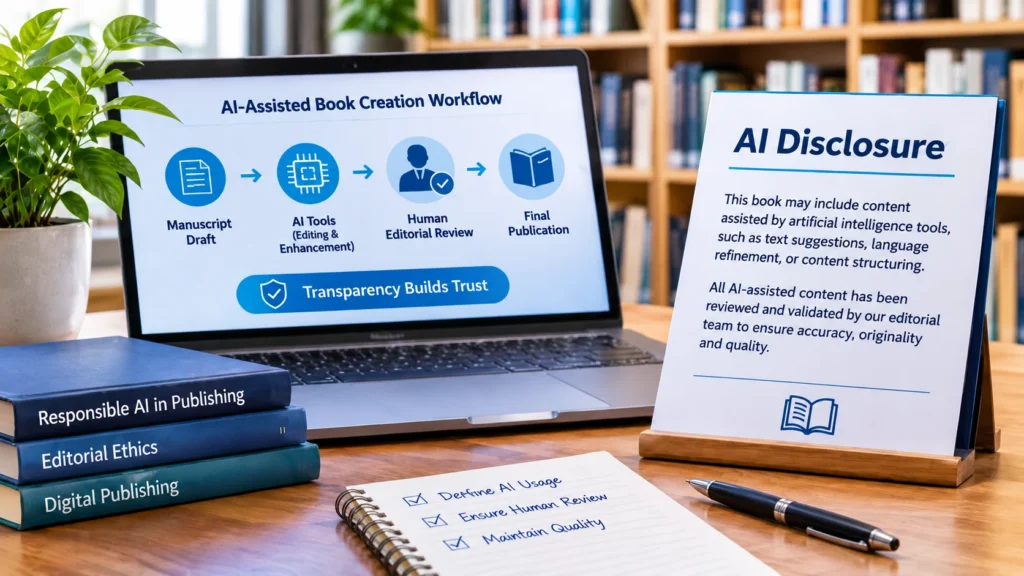
A reader-facing statement should answer three questions: what kind of AI use occurred, what human responsibility remained, and where in the production process it happened. For example: “The author used an AI language tool to suggest alternative headings.
The author selected, revised and approved the final text.” A more substantial use might say: “A machine-translation system produced a first draft of selected passages; a named human translator revised and approved the published translation.” Avoid language that implies the AI tool is a co-author or that the publisher can transfer responsibility to a vendor. The author and publisher remain accountable for the finished product under their own editorial and contractual policies.
Put publishing transparency where readers make decisions
A disclosure hidden in a technical policy page may satisfy an internal checkbox but fail readers at the point of choice. Depending on the format, publishers can place a concise note in front matter, acknowledgments, an endnote, the ebook’s accessible text, or a clearly linked title information page. For online retail listings, agree with platforms and distributors on how information can be presented consistently; do not assume every retailer offers a dedicated AI disclosure field.
Keep the wording aligned across print, ebook, audiobook and marketing assets. Where a book is updated, translated or reissued with materially different AI involvement, review whether its statement should change. Accessibility matters too: a disclosure should be available to screen readers and not rely only on a graphic badge.
Treat AI disclosure as part of rights and quality assurance
An AI disclosure policy cannot solve copyright, privacy, authorship or accuracy by itself. Before a tool is used, publishers should determine whether the provider’s terms allow the intended use, how submitted material is retained, whether content may be used for model training, and what rights exist in generated output.
Contracts should clarify who may authorize AI assistance, what uses are prohibited, what records must be retained and who must be notified. Editorial review remains essential: generated text can contain fabricated facts, untraceable quotations, biased descriptions or language too close to protected source material. An AI disclosure statement does not excuse a publisher from checking the work, obtaining permissions or correcting errors.
Illustrative scenario: a small publisher creates a clear policy
Imagine a hypothetical independent publisher preparing a nonfiction book with contributions from three authors. One author uses an AI tool to compare chapter outlines, another asks a grammar assistant to identify sentence-level issues, and the production team uses generated images for two chapter openers. The publisher’s policy classifies the outline and grammar support as internal record items, subject to author confirmation, while generated images require rights review and a visible disclosure.
The publisher checks the image service’s terms, commissions human review of each image and adds a short note to the ebook and print front matter. The authors approve the wording, and the marketing team receives the same disclosure guidance for catalogue copy. The process is illustrative, but shows how a single policy can accommodate different uses without treating them as equivalent.
A workable AI disclosure checklist
Publishers can begin with five steps. First, map where AI is already used across acquisition, editorial, translation, design, audio, metadata and marketing. Second, define materiality tiers with examples. Third, update author contracts, freelancer agreements, vendor reviews and internal submission forms.
Fourth, create reader-facing wording and decide where it appears in each format and channel. Fifth, audit a sample of titles and revise the policy as tools and reader expectations change. Involve authors, editors, production, legal, accessibility and marketing teams so the policy reflects the whole book lifecycle. The goal is not to label every keystroke. It is to give readers meaningful information and allow publishers to demonstrate that human responsibility, rights and quality controls remain in place.
Frequently Asked Questions
Does every use of AI need to be disclosed in a book?
Not necessarily. Publishers should define materiality thresholds. Routine spelling or formatting assistance may be recorded internally, while generated text, substantial rewriting, translation, illustrations or synthetic narration may warrant reader-facing disclosure.
What did the 85% survey result actually measure?
It measured U.S. book buyers’ views on whether books should disclose AI use in writing. It was based on 5,025 recent book buyers, not a global sample of all readers.
Should AI tools be listed as co-authors?
No. A tool cannot accept responsibility, sign a contract or answer for the content. The humans and organizations responsible for the work should be identified according to the publisher’s authorship and contributor policies.
Where should an AI disclosure appear?
Use a clear, accessible location such as front matter, an endnote, an ebook note or a linked title information page. Keep wording consistent across formats and retailer information where possible.
Can an AI detector determine whether a book needs disclosure?
A detector should not be the sole basis for a policy decision. Publishers should use contributor declarations, workflow records, rights checks and editorial review; detector outputs can be unreliable and should not replace evidence.
What should publishers ask authors to disclose?
Ask about the tool category, purpose, stage of work, content affected and human review performed. Explain that author declarations do not replace publisher controls over manuscripts, privacy or third-party services.
References and further reading
1. BookInsights.ai – What book buyers think about AI in books (Consumer Compass, October 2026)
2. Publishers Weekly – Survey Finds Book Buyers Split on AI Use (21 October 2026)